Increase in turnover after launching the new MassPayout direction.
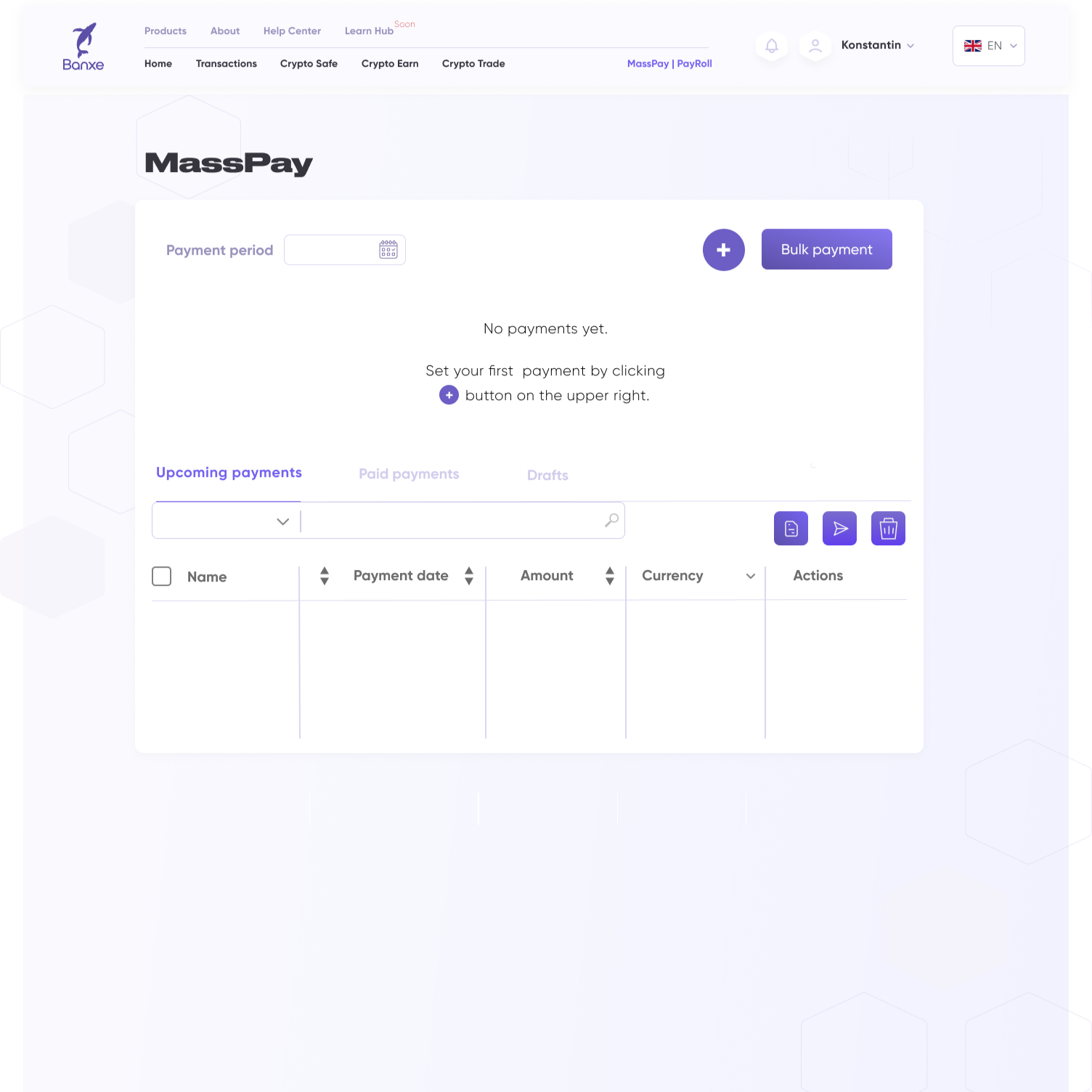



At a glance
The redesign keeps the fintech tone, large headline rhythm, and recognizable illustrations, but introduces clearer reading order and stronger hierarchy.
Increase in turnover after launching the new MassPayout direction.
Reduction in smart-contract development time after introducing new flows.
More successfully implemented DeFi integrations across the product ecosystem.
Increase in user activity during the first three months after release.
Context
Financial processes for both business clients and individual users were not efficient enough to support revenue growth and competitiveness. Payment management felt fragmented, transaction frequency was hard to control, and the experience made acquisition and retention more difficult.
Response
The answer was an expanded MassPayout direction for business clients plus a minimum viable product for individuals. That combination made the payment system more scalable, more usable, and more commercially meaningful.
Process
The original case already had a strong process spine. It is preserved here, but turned into a clearer two-level structure: four headline phases and five detailed delivery stages.
High-level flow
These original phase markers remain, but are easier to scan and understand.
Detailed stages
Development of detailed functional requirements for MassPayout, taking into account the needs of both corporate and individual clients.
Shape the first release around a focused B2B MVP and validate it with selected clients.
Use feedback loops to evolve the B2B direction and add the individual-user version.
Move the product into production and support adoption with training materials.
Continue measuring usage and tune the experience based on data and qualitative input.
Research layer
The original page had competitive research and a hand-drawn planning artifact. Here those two pieces become a clearer case-study section instead of getting lost in a long export.
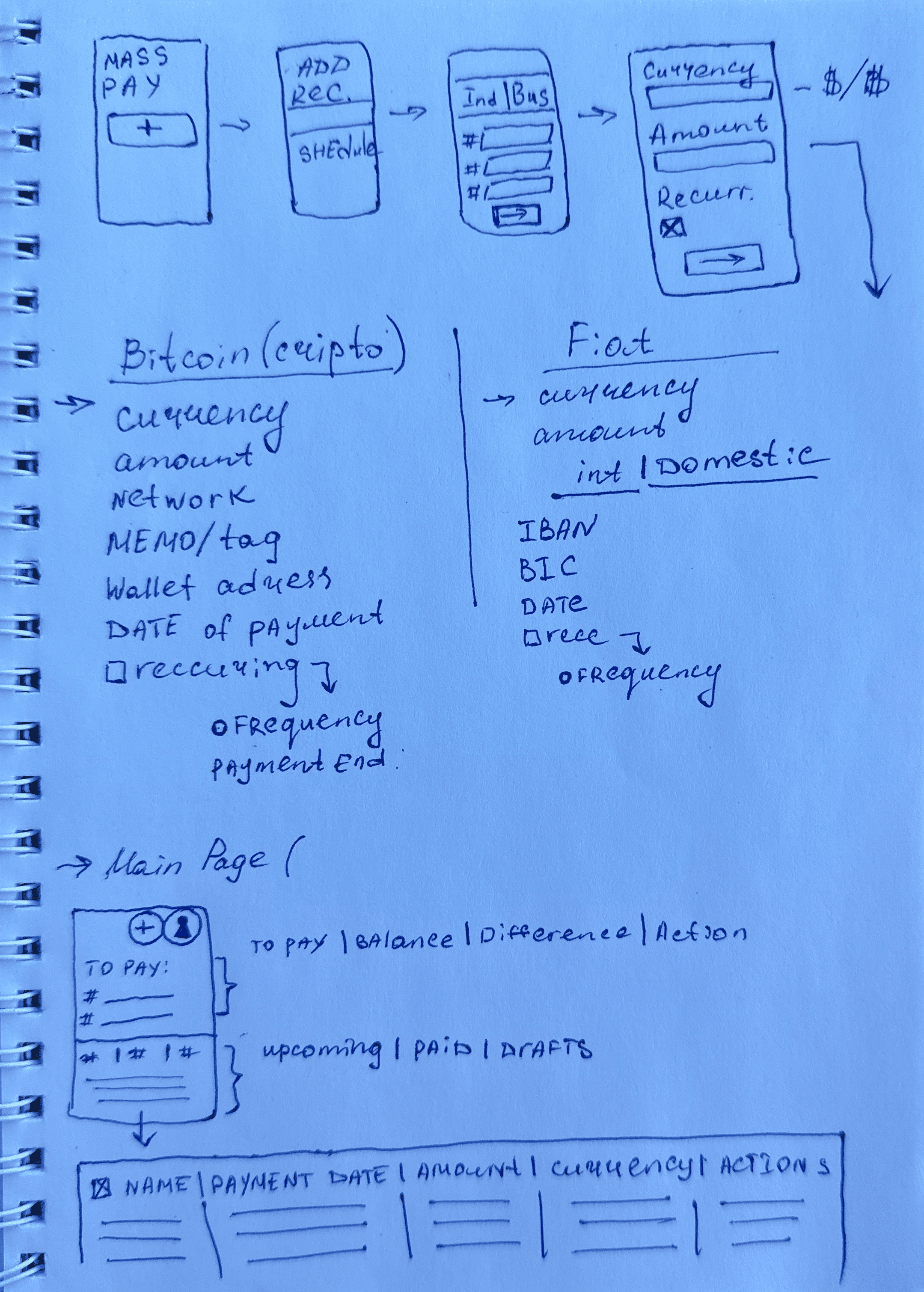
Early wireframes captured the payment structure, fiat and crypto branches, recurring logic, and the main-page rhythm before the UI system was formalized.
Competitive research focused on adjacent payment ecosystems and helped define how MassPayout should balance cross-border transfers, blockchain flows, bulk payments, and more familiar consumer finance behavior.

Benchmark for financial services and online money transfer workflows.

Reference point for blockchain payment gateways and crypto transaction patterns.

Useful comparison for global transfer clarity and international money movement.

Reference for familiar bill-payment and peer-to-peer money transfer behavior.
Product views
The screen selection below keeps the original visual evidence, but presents it as a readable sequence: dashboard, data entry, and bulk-payment confirmation.
The central overview screen for upcoming, paid, and draft payments.
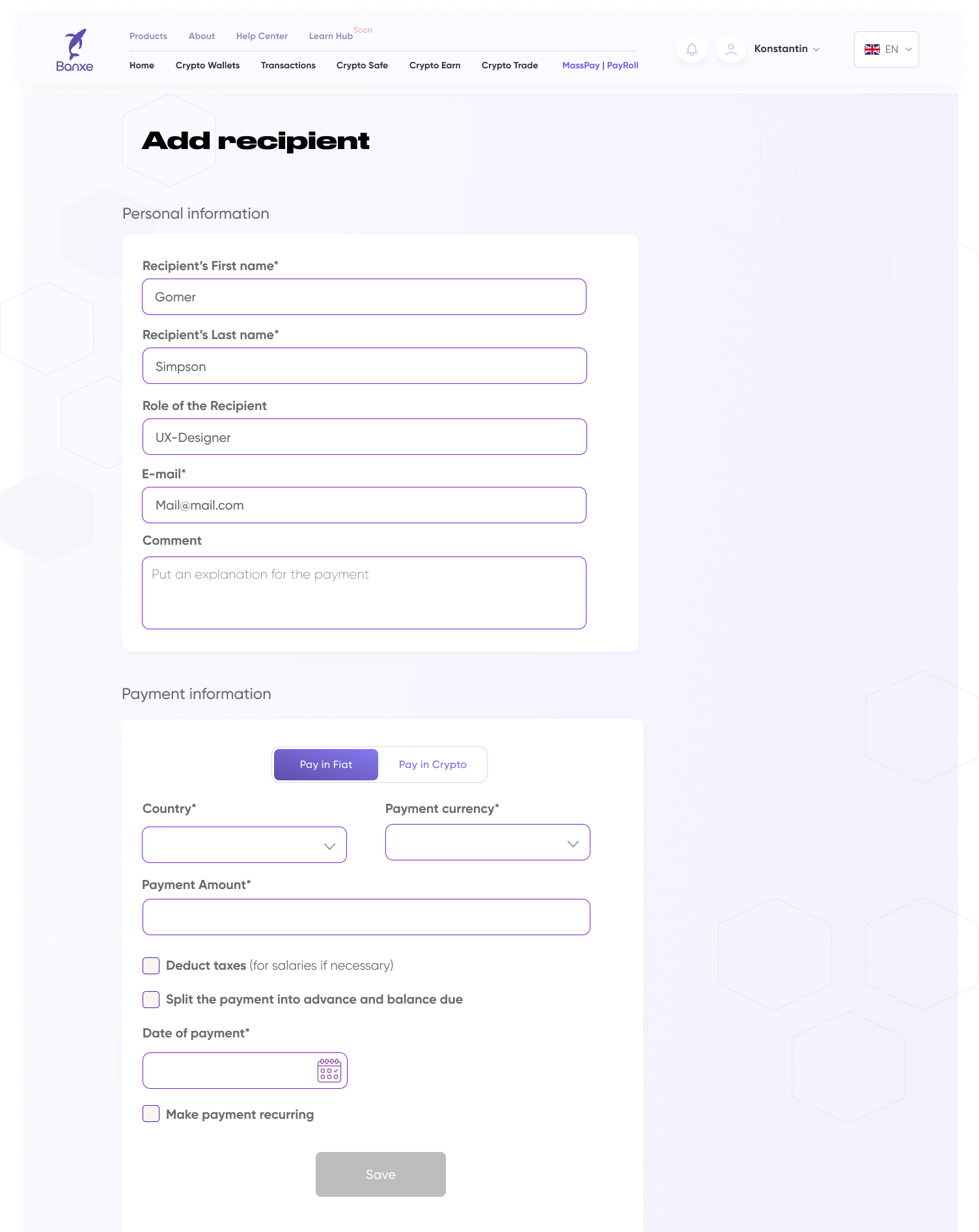
Structured data entry for personal and payment information in the fiat flow.
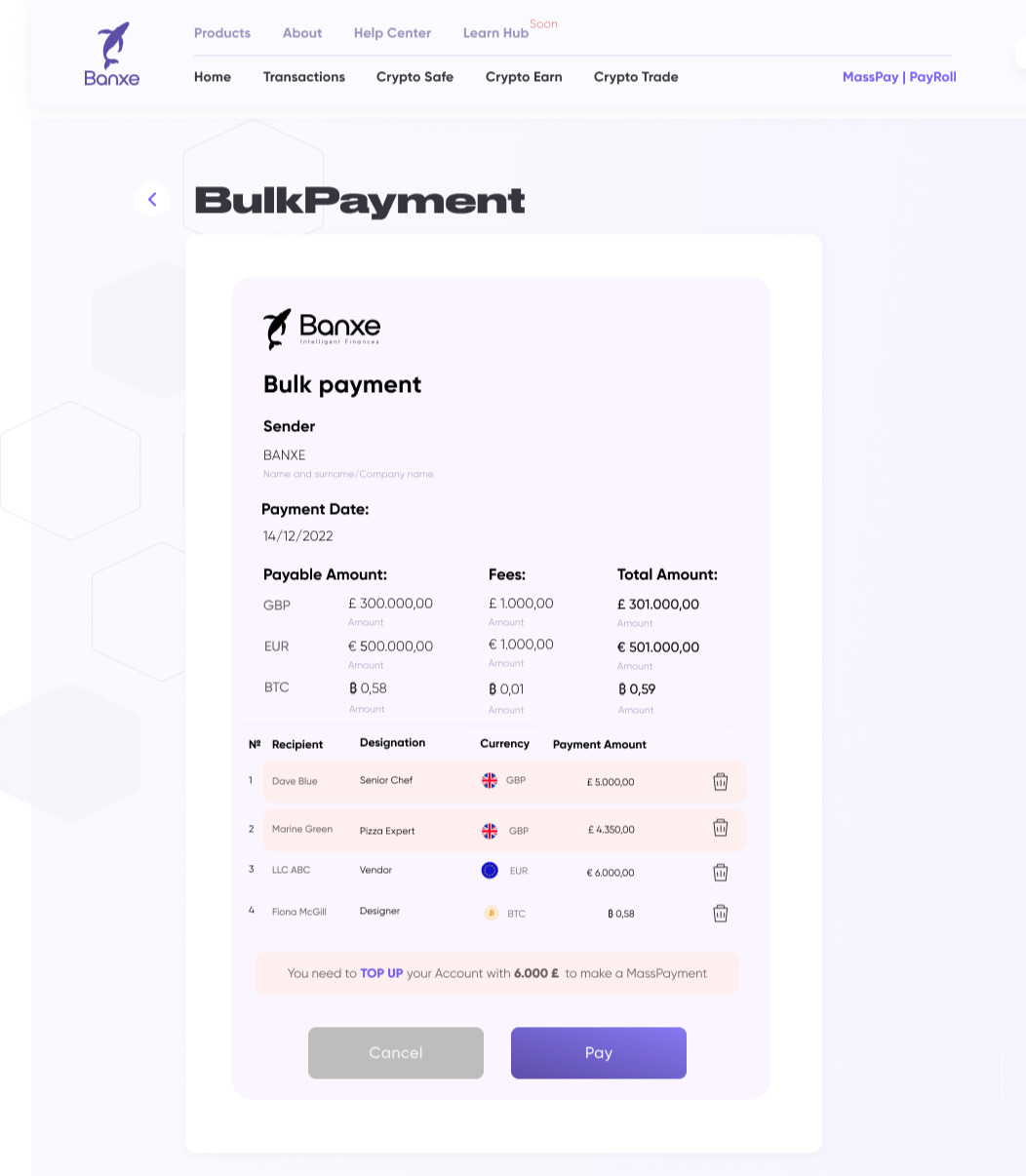
A confirmation step that translates complex payouts into a clearer decision point.
Outcome
The case closes not just with screens, but with measurable product impact and concrete delivery outputs that supported both launch and post-release learning.
The product direction led to a 35% turnover increase and created a more scalable financial experience across business and individual segments.
The original case also highlights a 20% reduction in smart-contract development time, 30% more successfully implemented DeFi integrations, and a 25% rise in user activity during the first three months after the new functionality launched.
Turnover growth after the MassPayout direction expanded.
Faster smart-contract development through clearer delivery structure.
Increase in successful DeFi integrations.
Higher user activity in the first three months after release.